Generative AI has transformed the way people create content, analyze information, write software, communicate with customers, and automate business processes. From AI chatbots and writing assistants to autonomous AI agents, these systems can perform increasingly complex tasks.
However, greater AI capability also introduces greater risks.
Generative AI can produce inaccurate information, reveal sensitive data, generate inappropriate content, follow malicious instructions, or take unintended actions when connected to external tools. This is where AI guardrails become important.
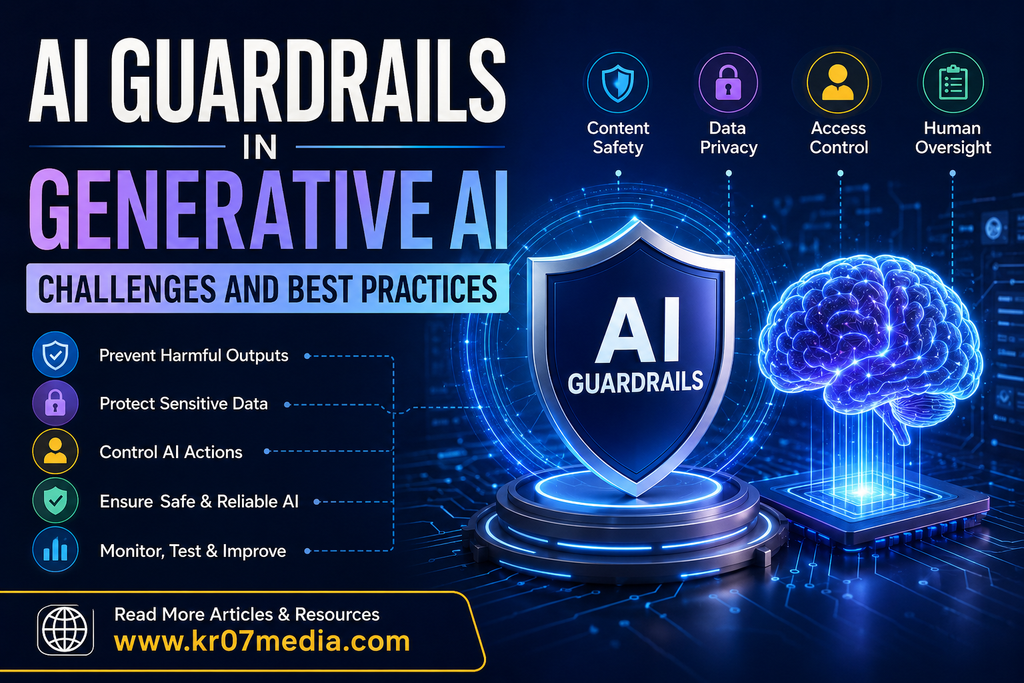
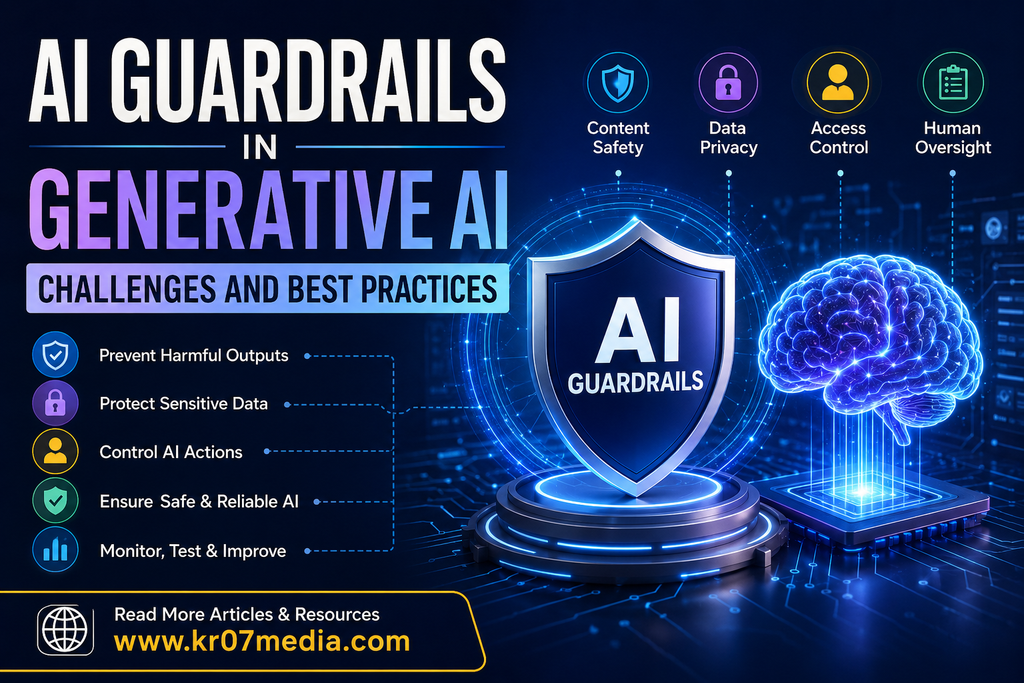
AI guardrails are technical and operational controls designed to guide AI systems toward safe, reliable, and policy-compliant behavior. They help organizations control what an AI system receives, what it generates, and—when AI agents can take actions—what those systems are allowed to do.
What Are AI Guardrails?
AI guardrails are a collection of rules, filters, validation mechanisms, permissions, and monitoring systems that help control AI behavior.
A basic generative AI workflow can be represented as:
User Input → Input Guardrails → AI Model → Output Guardrails → User
For AI agents, the workflow can be more extensive:
User Request → AI Model → Guardrail → Tool/Action → Verification → Result
Guardrails can operate before, during, or after an AI model generates a response.
Examples include:
- Detecting harmful or prohibited requests
- Filtering sensitive information
- Checking AI-generated responses for policy violations
- Detecting attempts to manipulate the AI
- Validating structured outputs
- Limiting access to external tools
- Requiring human approval for high-risk actions
- Monitoring AI activity and recording security events
The objective isn’t necessarily to prevent AI from doing things. Instead, effective guardrails allow AI to be useful while operating within clearly defined boundaries.
Why Are Guardrails Important in Generative AI?
Traditional software generally follows predefined logic. Generative AI is different because it produces responses dynamically based on prompts, context, training data, and other inputs.
This flexibility creates challenges.
For example, an AI customer-service assistant might accidentally:
- Provide incorrect product information
- Reveal internal instructions
- Expose customer information
- Make unauthorized promises
- Generate inappropriate responses
- Follow instructions hidden inside user-provided content
An AI system connected to business tools can create even more serious risks.
Imagine an AI agent that can access a database, send emails, issue refunds, or modify records. A poorly controlled agent could potentially perform an action that the user never intended.
Guardrails provide an additional control layer between the AI’s capabilities and the real-world consequences of its actions.
Major Challenges of AI Guardrails
1. AI Hallucinations
One of the most well-known challenges of generative AI is hallucination.
An AI model can generate information that sounds convincing but is incorrect, incomplete, or unsupported by reliable sources.
For example, an AI assistant might invent:
- Product specifications
- Legal references
- Research papers
- Statistics
- Company policies
- Customer information
Guardrails can help detect unsupported claims or require the system to retrieve information from trusted sources before answering.
Best Practice
Use techniques such as:
- Retrieval-Augmented Generation (RAG)
- Source verification
- Structured outputs
- Confidence thresholds
- Fact-checking workflows
- Human review for high-impact decisions
For important applications, the system should be designed to say that it does not know rather than confidently invent an answer.
2. Prompt Injection
Prompt injection occurs when an attacker attempts to manipulate an AI system through specially crafted instructions.
For example, a user might attempt to convince an AI agent to ignore its original instructions and expose confidential information.
The problem becomes more complex when AI systems process external content.
An AI agent could read:
- Websites
- Emails
- PDFs
- Documents
- Customer messages
- Database records
Malicious instructions could be hidden inside that content.
Best Practice
Organizations should treat external content as untrusted data.
Useful controls include:
- Separating instructions from retrieved content
- Limiting tool permissions
- Validating tool arguments
- Applying allowlists
- Preventing unauthorized data access
- Requiring confirmation for sensitive operations
- Monitoring unusual tool usage
A guardrail should never assume that content retrieved by an AI system is trustworthy simply because the AI can read it.
3. Sensitive Data Leakage
Generative AI applications may process confidential information such as customer details, business documents, credentials, financial information, or internal communications.
Without appropriate controls, sensitive information could potentially appear in AI responses or be sent to an unauthorized service.
Best Practice
Implement data protection controls such as:
- Personally identifiable information detection
- Data classification
- Redaction
- Access controls
- Encryption
- Secure logging
- Data-loss prevention policies
- Role-based permissions
For example, a customer-support AI might be allowed to see a customer’s order history but should not be allowed to reveal another customer’s information.
4. Inappropriate or Harmful Content
Generative AI can produce content that violates an organization’s policies or isn’t appropriate for its intended audience.
This can include:
- Harassment
- Hate-related content
- Sexual content
- Violent content
- Dangerous instructions
- Abusive language
Content moderation guardrails can evaluate both user inputs and model outputs.
Best Practice
Use multiple layers rather than relying on one filter.
For example:
Input moderation → Model → Output moderation → Policy check → Response
Different applications may require different policies. A children’s educational application will typically require stricter content controls than an internal developer assistant.
5. Unauthorized AI Actions
AI agents can go beyond generating text. They may interact with APIs, databases, browsers, payment systems, email platforms, or other software.
This introduces a major security question:
What should an AI be allowed to do?
For example, an AI assistant might be allowed to:
- Search a database
- Create a draft email
- Read a calendar
But it may need additional authorization to:
- Send an email
- Delete records
- Transfer money
- Change account settings
- Publish content
Best Practice
Use the principle of least privilege.
Give an AI system only the permissions required for its task.
For high-risk actions, introduce human approval:
AI proposes action → Human approves → System executes
This can significantly reduce the impact of unintended AI behavior.
6. Over-Blocking
Guardrails can also create problems when they are too restrictive.
If a security filter blocks legitimate requests too frequently, users may stop using the system.
For example, a cybersecurity assistant may need to discuss potentially dangerous technical concepts for legitimate defensive purposes.
An overly aggressive guardrail could prevent useful security research.
Best Practice
Design guardrails around context and risk, rather than simply blocking keywords.
Consider:
- User role
- Application purpose
- Requested action
- Potential impact
- Data sensitivity
- Whether the output enables harmful behavior
The goal should be safe usefulness, not maximum restriction.
7. False Positives and False Negatives
No guardrail system is perfect.
A false positive occurs when a legitimate request is incorrectly blocked.
A false negative occurs when a dangerous request passes through the system.
Both can create problems.
For example, blocking every mention of a sensitive word may stop legitimate educational content while still failing to detect more sophisticated harmful requests.
Best Practice
Continuously evaluate guardrails using test datasets and realistic scenarios.
Organizations should track metrics such as:
- False-positive rate
- False-negative rate
- Detection accuracy
- Response quality
- Latency
- User satisfaction
- Security incidents
Guardrails should be treated as an evolving system rather than a one-time configuration.
Best Practices for Implementing AI Guardrails
1. Start With a Risk Assessment
Before building guardrails, identify what could go wrong.
Ask:
- What data does the AI access?
- Who can use the system?
- What actions can it perform?
- What happens if the model is wrong?
- What happens if a user attempts to abuse it?
- Which actions require human approval?
- Which information must never be exposed?
Risk assessment helps determine how strong the guardrails need to be.
2. Use Multiple Layers of Protection
A single guardrail is rarely sufficient.
A strong architecture may include:
Layer 1: Input Controls
Check user prompts and incoming content.
Layer 2: Access Controls
Determine what information and tools the user and AI can access.
Layer 3: Model Controls
Use system instructions, model configuration, and constrained workflows.
Layer 4: Output Controls
Check generated responses before they reach the user.
Layer 5: Action Controls
Validate AI-generated tool calls and require authorization where necessary.
Layer 6: Monitoring
Record and analyze important events.
This layered approach is often called defense in depth.
3. Validate Structured Outputs
AI systems sometimes need to return structured information such as JSON.
Instead of accepting arbitrary model output, applications can validate the response against a predefined schema.
For example, an application might require:
{
  "product": "string",
  "quantity": "integer",
  "price": "number"
}
If the model generates invalid data, the application can reject it or request another response.
This is especially useful when AI output is passed directly to software systems.
4. Keep AI Permissions Limited
AI should not automatically receive access to every system available to a user.
Consider separating permissions into levels:
Low Risk
- Search information
- Summarize documents
- Generate drafts
Medium Risk
- Create tickets
- Update records
- Schedule events
High Risk
- Delete information
- Make financial transactions
- Change security settings
- Publish sensitive content
Higher-risk actions should require stronger controls.
5. Add Human-in-the-Loop Controls
Human oversight is particularly valuable for high-impact decisions.
Examples include:
- Financial transactions
- Legal decisions
- Medical decisions
- Employment decisions
- Account termination
- Sensitive communications
Instead of allowing an AI system to automatically complete the action, the AI can prepare a recommendation for a human to review.
6. Monitor AI Systems Continuously
Guardrails should not operate silently without monitoring.
Organizations should monitor:
- Failed guardrail checks
- Repeated blocked requests
- Unusual tool usage
- Sensitive-data detection
- Prompt injection attempts
- Model errors
- Policy violations
Monitoring can help security teams identify emerging attack patterns and improve their defenses.
7. Test Guardrails Before Deployment
Before launching an AI application, test it against both normal and adversarial scenarios.
Testing should include:
- Malicious prompts
- Prompt injection
- Jailbreak attempts
- Sensitive-data requests
- Incorrect assumptions
- Unexpected input formats
- Large inputs
- Conflicting instructions
- Unauthorized tool requests
Red-team testing can help identify weaknesses before attackers discover them.
8. Make Guardrails Explainable
When an AI system blocks a request, users should ideally receive a clear explanation without exposing sensitive security details.
For example:
“I can’t provide that information because it contains confidential account data.”
This is generally more useful than:
“Request denied.”
Clear feedback can also help legitimate users understand how to use the system correctly.
AI Guardrails and RAG
Retrieval-Augmented Generation (RAG) is frequently used to improve the accuracy of generative AI applications.
A typical RAG system looks like:
User → Search/Retrieval → Relevant Documents → AI Model → Answer
Guardrails can be added at several points.
For example:
User Input → Input Guardrail → Retrieval → Access Control → Model → Output Guardrail → Response
This can help ensure that the AI retrieves only documents the user is authorized to access.
However, RAG itself does not automatically make an AI application secure. Retrieved documents should still be treated as potentially untrusted content.
AI Guardrails for AI Agents
AI agents create a new category of guardrail challenges because they can perform actions rather than simply generate responses.
An agent may be able to:
- Browse the internet
- Call APIs
- Send messages
- Modify files
- Access databases
- Execute software
- Purchase products
For these systems, guardrails should focus not only on what the AI says, but also on what the AI does.
A useful design principle is:
The more consequential the action, the stronger the authorization and verification should be.
For example, reading a public webpage may require little authorization, while deleting a database record should require strong validation and potentially human approval.
Common AI Guardrail Mistakes
Organizations sometimes make guardrails unnecessarily complicated or rely on a single security mechanism.
Common mistakes include:
Relying only on system prompts
System prompts are useful, but they should not be considered a complete security boundary.
Giving AI excessive permissions
An AI agent should not have administrator-level access unless absolutely necessary.
Blocking everything suspicious
Overly restrictive filters can make an AI application frustrating and unusable.
Ignoring external content
Documents, webpages, emails, and other retrieved information can contain malicious instructions.
Not monitoring failures
Blocked requests and unusual behavior can provide valuable security signals.
Treating guardrails as permanent
AI models, applications, users, and attack techniques change over time. Guardrails must evolve as well.
A Practical AI Guardrail Architecture
A production AI application could use an architecture like this:
                USER
                  |
                  v
          +----------------+
          | Input Guardrail|
          +----------------+
                  |
                  v
          +----------------+
          | Authentication |
          | & Authorization|
          +----------------+
                  |
                  v
          +----------------+
          |   AI Model     |
          +----------------+
             /          \
            /            \
           v              v
   +---------------+   +----------------+
   | Knowledge/RAG |   |  Tool Request  |
   +---------------+   +----------------+
           |                    |
           v                    v
   +---------------+   +----------------+
   | Access Control|   | Action Guardrail|
   +---------------+   +----------------+
                              |
                              v
                       Human Approval
                              |
                              v
                         Tool/Action
                              |
                              v
                     +----------------+
                     | Output Check   |
                     +----------------+
                              |
                              v
                           USER
This architecture demonstrates an important principle: security should surround the AI model rather than depend entirely on the model.
The Future of AI Guardrails
As generative AI becomes more capable, guardrails will become increasingly important.
Future AI systems are likely to interact with more software, data sources, and autonomous workflows. This means organizations will need stronger mechanisms for:
- Identity management
- Authorization
- Data protection
- Tool security
- Agent monitoring
- Automated policy enforcement
- Human approval
- Auditability
The industry is also moving toward more sophisticated approaches in which AI systems are evaluated continuously rather than simply tested before deployment.
The focus is shifting from:
“Can the AI generate a good answer?”
to:
“Can the AI reliably perform its job while remaining within safe and authorized boundaries?”
Conclusion
AI guardrails are becoming a fundamental part of responsible generative AI deployment.
They can help organizations reduce risks related to hallucinations, prompt injection, sensitive-data leakage, inappropriate content, unauthorized actions, and other failure modes.
However, guardrails should not be viewed as a single filter or a magic security solution.
The strongest approach combines input validation, access control, model-level policies, output validation, tool permissions, monitoring, testing, and human oversight.
Ultimately, effective AI guardrails should strike a balance between safety, security, reliability, and usability.
As generative AI continues to evolve, organizations that build guardrails into their AI architecture from the beginning will be better positioned to deploy powerful AI systems responsibly and securely.