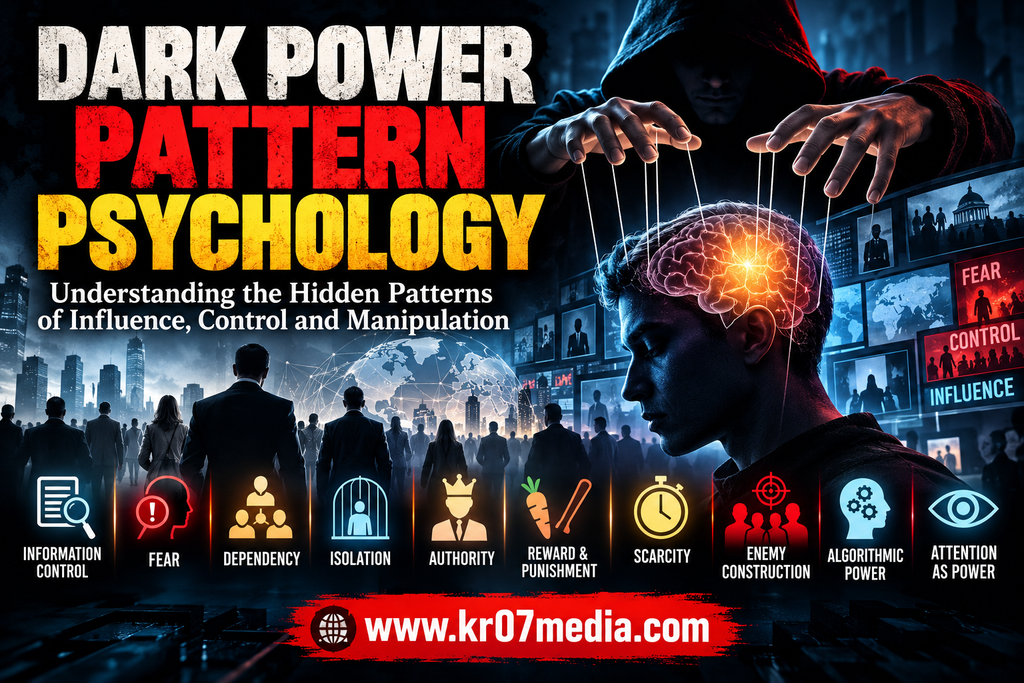
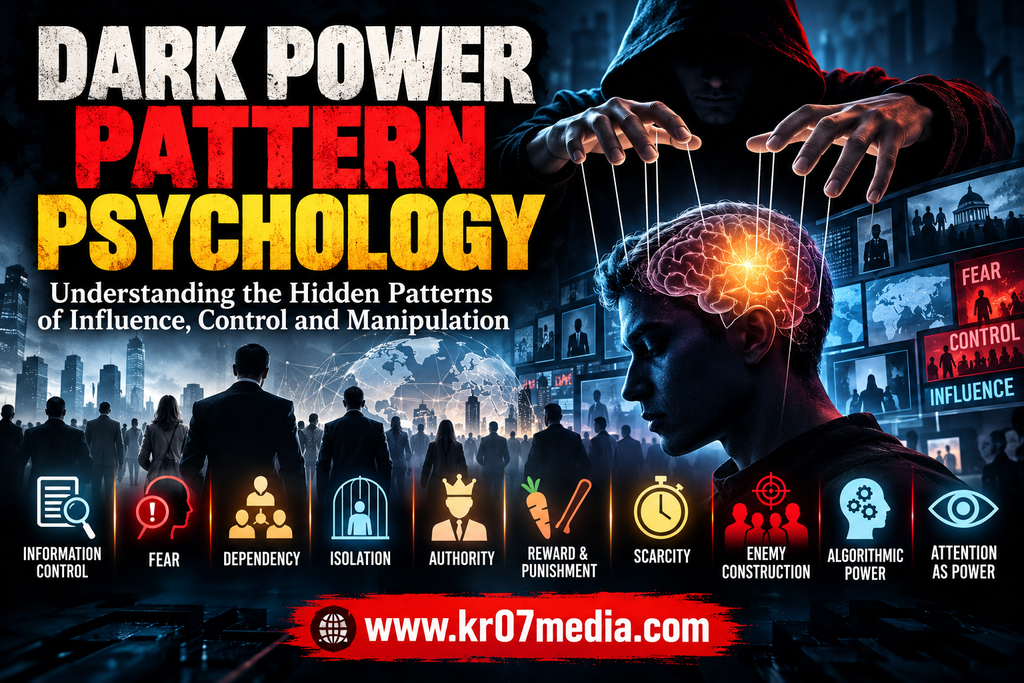
Dark power pattern psychology refers to the study of recurring psychological patterns through which individuals, groups, institutions, or systems attempt to gain influence, maintain authority, control behavior, or shape decisions. The term is not a single established clinical diagnosis or universally defined psychological theory. Rather, it can be used as a framework for examining the darker side of power dynamics.
Power itself is not necessarily harmful. Leadership, negotiation, persuasion, authority, and social coordination are normal parts of human life. The problem begins when power becomes dependent on fear, deception, dependency, information asymmetry, coercion, or psychological manipulation.
Understanding these patterns can help people recognize unhealthy power relationships without assuming that every disagreement or authority structure is secretly manipulative.
1. What Is a Dark Power Pattern?
A dark power pattern can be understood as a repeated behavioral structure in which one party attempts to increase its control over another.
A simplified pattern is:
Information → Interpretation → Emotion → Decision → Dependency → Control
For example, someone withholds important information, provides a selective interpretation, creates urgency or fear, influences the target’s decision, and then makes the target increasingly dependent on them.
The important point is that one isolated behavior does not necessarily prove manipulation. Patterns become more meaningful when the same structure repeatedly appears over time.
2. The Psychology of Power
Power generally comes from several sources:
- Control over resources
- Knowledge or information
- Social status
- Institutional authority
- Economic dependence
- Expertise
- Physical capability
- Network connections
- Control over opportunities
- Ability to reward or punish
Psychologically, people often respond to power through a combination of trust, fear, admiration, conformity, self-interest, and perceived legitimacy.
A person may follow an authority figure because they believe:
“This person knows better.”
Another person may follow because:
“I have no practical alternative.”
Those two situations can look similar externally while being psychologically very different.
3. The Information-Control Pattern
One of the most important power mechanisms is control over information.
Information creates an asymmetry:
Person A knows X.
Person B does not know X.
If Person A controls whether Person B receives X, A may gain decision-making power.
This can occur in ordinary situations:
- Workplace decisions
- Political communication
- Financial negotiations
- Online platforms
- Family relationships
- Corporate structures
- Social groups
A darker version occurs when information is deliberately manipulated.
Examples include:
Selective disclosure:
Only favorable information is provided.
Information overload:
So much information is presented that the important facts become difficult to identify.
Strategic ambiguity:
Statements remain deliberately unclear.
Information withholding:
Relevant information is intentionally kept from the other party.
The key question is not simply:
“Who has more information?”
It is:
“Who controls the flow of information, and who benefits from that control?”
4. Fear as a Power Mechanism
Fear can dramatically change decision-making.
When people perceive a serious threat, their attention often becomes concentrated on immediate survival or avoidance.
This creates a powerful psychological structure:
Threat → Anxiety → Reduced exploration → Immediate compliance
A person who is frightened may accept an option they would reject under normal circumstances.
Fear-based influence can involve:
- Threats of punishment
- Social exclusion
- Loss of employment
- Financial insecurity
- Reputation damage
- Uncertainty about the future
- Catastrophic predictions
However, legitimate warnings should not automatically be classified as manipulation.
For example, telling someone about a genuine financial risk is different from exaggerating the risk specifically to control their behavior.
5. Dependency and the Power Loop
Dependency is another major component of dark power dynamics.
Suppose:
A provides something B cannot easily obtain elsewhere.
A may gradually acquire influence over B.
The dependency can involve:
- Money
- Employment
- Information
- Emotional validation
- Social connections
- Housing
- Technology
- Access to opportunities
The more alternatives disappear, the greater the potential power imbalance becomes.
This produces a feedback loop:
Dependency → Reduced alternatives → Greater compliance → Greater dependency
Breaking this loop often requires restoring alternatives rather than simply arguing with the person holding power.
6. Psychological Gaslighting
Gaslighting is commonly used to describe patterns in which someone’s perception of reality is systematically challenged or distorted.
It may involve statements such as:
- “That never happened.”
- “You’re imagining things.”
- “Everyone agrees with me.”
- “You’re the problem.”
- “You can’t trust your own judgment.”
However, disagreement is not automatically gaslighting.
A useful distinction is pattern and intent.
If two people genuinely remember an event differently, that is ordinary disagreement.
If someone repeatedly denies observable events, manipulates evidence, isolates the other person from alternative sources of information, and uses the resulting confusion to gain control, the pattern becomes much more concerning.
7. The Isolation Pattern
Control becomes easier when alternative sources of information disappear.
Isolation can be:
Physical
Reducing someone’s contact with others.
Social
Creating conflict between the person and their friends or colleagues.
Informational
Discouraging exposure to alternative viewpoints.
Psychological
Convincing someone that nobody else understands them.
A common structure is:
Outside information decreases → Dependence increases → Controller’s interpretation becomes dominant
This is why independent relationships and independent information sources can act as safeguards against excessive power.
8. The Authority Pattern
Authority can become psychologically powerful because humans frequently use shortcuts when making decisions.
Instead of independently evaluating every claim, people may think:
“An expert said it, therefore it must be correct.”
Authority can be legitimate when it is supported by:
- Expertise
- Evidence
- Accountability
- Transparency
- Consistent rules
The darker pattern occurs when authority becomes immune to questioning.
Warning signs include:
- “Don’t question me.”
- “Because I said so.”
- “You don’t need to know.”
- “Only insiders understand.”
- “Disagreement proves disloyalty.”
A healthy authority structure allows verification and challenge.
9. The Loyalty Test
Some power structures gradually transform disagreement into a test of loyalty.
The psychological equation becomes:
Agreement = loyalty
Disagreement = betrayal
This is particularly powerful in highly hierarchical organizations or groups.
Once disagreement becomes dangerous, people may stop expressing what they actually think.
This produces another phenomenon:
Preference falsification
People privately believe one thing but publicly express another because the social cost of honesty is too high.
As more people do this, the organization may develop a false appearance of unanimous agreement.
10. Reward and Punishment
Power can also operate through behavioral conditioning.
A simple structure is:
Desired behavior → Reward
Undesired behavior → Punishment
Rewards may include:
- Money
- Promotion
- Recognition
- Access
- Status
- Approval
Punishments may include:
- Exclusion
- Reduced opportunities
- Criticism
- Financial penalties
- Loss of status
Reward and punishment themselves are not inherently manipulative. Parents, employers, schools, and governments all use legitimate incentive structures.
The darker pattern emerges when rewards and punishments are arbitrary, hidden, disproportionate, or deliberately designed to create psychological dependency.
11. The Scarcity Pattern
Scarcity can increase perceived value.
Psychological messages such as:
“This is your last chance.”
“There will never be another opportunity.”
“Decide immediately.”
can reduce deliberate thinking.
This is why urgency is frequently used in:
- Sales
- Negotiations
- Political campaigns
- Online marketing
- Social influence
The important distinction is whether the scarcity is real or manufactured.
Real scarcity is a property of the situation.
Manufactured scarcity is a psychological mechanism designed to make people act before they have enough information.
12. The Enemy Construction Pattern
Some power systems strengthen internal cohesion by identifying an external enemy.
The structure becomes:
We are threatened → We must unite → Internal disagreement is dangerous → Authority must become stronger
The enemy may be:
- Another organization
- A political group
- A competitor
- A social category
- A foreign country
- An ideological opponent
The existence of a genuine external threat does not automatically make the response manipulative.
The warning sign is when the threat is exaggerated, fabricated, or continuously used to justify increasing control.
13. The Complexity Trap
Complexity itself can become a source of power.
When a system becomes extremely complicated, ordinary people may feel incapable of questioning it.
Examples include:
- Complicated financial systems
- Legal structures
- Technical infrastructure
- Bureaucratic procedures
- Algorithmic systems
Complexity creates an important question:
Is the complexity necessary, or does the complexity itself protect the power structure from scrutiny?
This is especially important in technological systems.
14. Algorithmic Power
Modern technology creates a new form of psychological power.
Traditional power often operated through people.
Digital power can operate through:
Algorithms → Interfaces → Recommendations → Attention → Behavior
A platform may influence what users:
- See
- Read
- Buy
- Watch
- Click
- Share
- Ignore
This does not necessarily mean that a hidden controller is manipulating every individual.
Instead, algorithmic systems often optimize measurable objectives such as:
- Engagement
- Revenue
- Retention
- Conversion
- Personalization
The resulting behavior can have psychological consequences even without a single person deliberately controlling each outcome.
15. Attention as Power
One of the most important resources in the digital era is human attention.
If an organization can repeatedly capture attention, it can influence:
What people notice → What they think about → What they discuss → What they consider important
This does not mean attention determines beliefs completely.
People retain independent judgment, and different people interpret the same information differently.
But controlling attention can influence the starting point of decision-making.
16. The Self-Doubt Pattern
A particularly powerful form of psychological control occurs when a person gradually loses confidence in their own judgment.
The cycle can look like:
Decision → External criticism → Self-doubt → Dependence on external validation → Reduced confidence → More external dependence
Breaking this pattern requires restoring independent evaluation.
Useful questions include:
- What do I actually know?
- What am I assuming?
- What evidence would change my mind?
- Who benefits from this interpretation?
- What alternative explanation exists?
- Can I independently verify the claim?
17. The Darkest Pattern: Control of the Control System
A deeper level of analysis asks not merely:
“Who controls people?”
but:
“Who controls the rules through which control operates?”
Consider a simplified hierarchy:
Individual
↓
Organization
↓
Rules
↓
Institutions
↓
Infrastructure
↓
Information systems
At each level, power can potentially influence the level below it.
For example, controlling individual decisions is one form of power.
Controlling the rules that determine available decisions is a deeper form.
And controlling the infrastructure through which those rules operate can create an even broader structural advantage.
This is sometimes called meta-power: power over the conditions under which other forms of power operate.
18. Pattern Recognition Without Paranoia
Studying dark power psychology has one major danger: seeing manipulation everywhere.
Humans are naturally good at detecting patterns, but this ability can produce false positives.
For example:
Event A + Event B + Event C
does not automatically mean:
Someone intentionally designed A + B + C.
There are at least four possibilities:
- Intentional manipulation
- Structural incentives
- Unintended consequences
- Random coincidence
Good analysis keeps all four possibilities open until evidence separates them.
19. A Practical Dark Power Detection Framework
When examining a potentially manipulative situation, ask seven questions:
1. Who has power?
Identify the person, organization, or system capable of influencing the outcome.
2. What resource creates the power?
Money? Information? Authority? Access? Technology? Social status?
3. What behavior is being encouraged?
Identify the desired action.
4. What happens if someone refuses?
Look for explicit or implicit consequences.
5. Who controls information?
Determine whether all relevant parties have comparable access to evidence.
6. Who benefits?
Benefits may be financial, political, psychological, organizational, or reputational.
7. What evidence could prove the interpretation wrong?
This final question is extremely important.
A theory that cannot possibly be disproved can easily become a self-reinforcing belief.
20. How to Protect Against Dark Power Patterns
Protection does not require rejecting all authority or institutions.
Instead, develop independent verification.
Useful safeguards include:
- Maintain multiple information sources.
- Preserve financial and practical alternatives.
- Ask for evidence.
- Separate facts from interpretations.
- Slow down decisions involving extreme urgency.
- Document important communications.
- Maintain independent relationships.
- Learn enough about complex systems to ask meaningful questions.
- Distinguish incentives from intentions.
- Question your own assumptions as well as other people’s claims.
The objective is not permanent suspicion.
It is epistemic independence—the ability to evaluate information without becoming completely dependent on one source of authority.
Conclusion
Dark power pattern psychology is ultimately about understanding how influence becomes control.
The most important patterns include:
Information asymmetry → Fear → Dependency → Isolation → Authority → Conditioning → Attention control → Behavioral influence
But these mechanisms exist on a spectrum. The presence of influence does not automatically prove malicious intent.
The strongest analysis therefore avoids two extremes:
“Everything is manipulation.”
and
“Nothing is manipulation.”
A more useful position is:
Observe the pattern, identify the incentives, examine the evidence, test alternative explanations, and remain uncertain where the evidence is insufficient.
Power becomes most difficult to challenge when it controls not only people’s actions, but also the information, rules, incentives, and narratives through which people understand their own choices.
Understanding those mechanisms does not automatically free someone from them—but it creates the possibility of seeing the structure clearly enough to make more independent decisions.