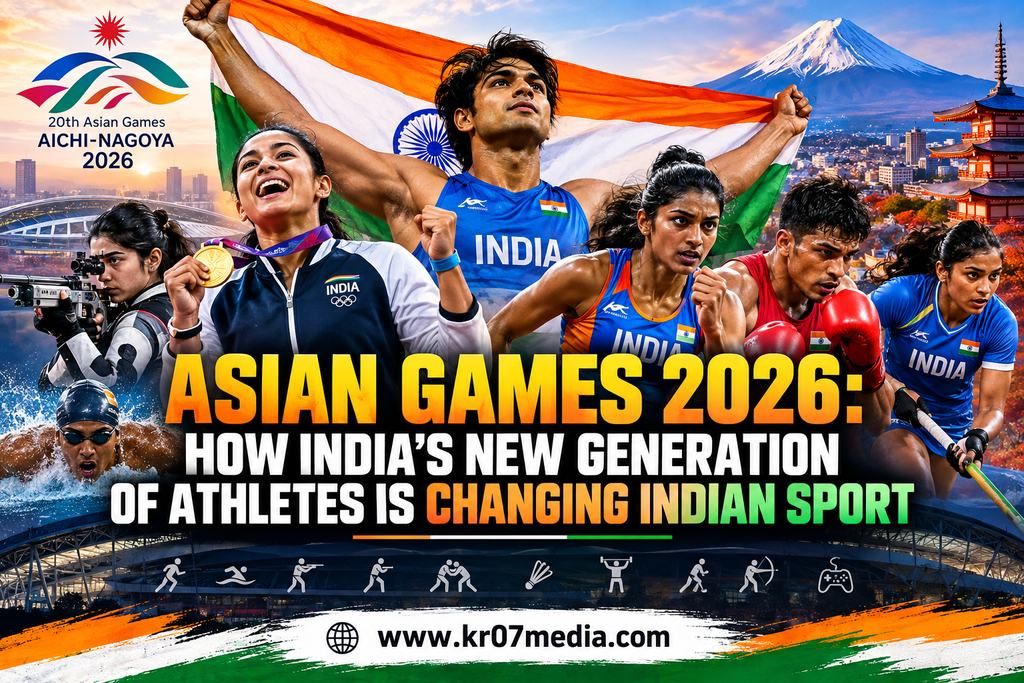
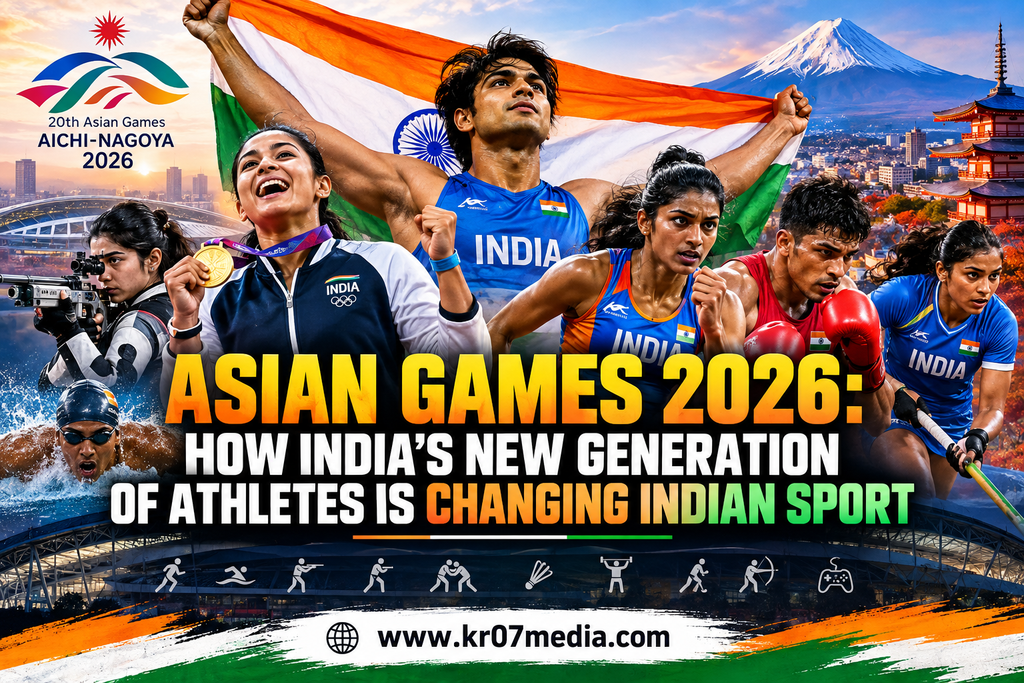
The Asian Games have traditionally been viewed in India through the lens of medals. Gold, silver and bronze have been the simplest way to measure progress.
But the Aichi-Nagoya Asian Games 2026 are revealing a larger transformation.
India entered the 20th Asian Games with a contingent of more than 500 athletes competing across 36 disciplines. The Games are being held in Japan from 19 September to 4 October 2026.
Three years after India’s record 107-medal performance at Hangzhou, the important question is no longer simply how many medals India can win.
It is this:
What kind of sporting nation is India becoming?
The answer can be seen in the changing age profile of athletes, the emergence of sports beyond cricket, the growing participation of women, grassroots programmes, professional coaching, sports science and athletes coming from smaller cities and rural communities.
The 2026 Asian Games therefore represent more than another continental competition. They provide a window into the changing architecture of Indian sport.
From Individual Champions to a Sporting Generation
Indian sport has always produced exceptional individuals.
Milkha Singh, P.T. Usha, Viswanathan Anand, Leander Paes, Abhinav Bindra, Mary Kom, Sushil Kumar and others demonstrated that Indian athletes could compete with the world’s best.
But individual brilliance is different from creating a sustainable sporting ecosystem.
The emerging generation is increasingly growing within an ecosystem of:
- structured talent identification,
- national training camps,
- professional coaching,
- sports science,
- nutrition,
- international exposure,
- financial support,
- specialist equipment,
- performance analytics,
- and increasingly sophisticated competition pathways.
That change is visible in the composition of India’s 2026 Asian Games team.
The Olympic Council of Asia reported an initial Indian contingent of 492 athletes—265 men and 227 women. The contingent subsequently expanded, with the final Indian delegation reported at 503 athletes across 36 disciplines.
The numbers themselves tell an important story.
India is no longer relying exclusively on a handful of established stars.
It is attempting to build a pipeline.
The New Athlete Is Being Developed Differently
The traditional Indian sporting journey could be difficult.
A talented child might be discovered locally, compete at state level and eventually reach national competition. Along the way, access to facilities, coaching, equipment and travel could determine whether talent survived.
That model is gradually changing.
The Khelo India ecosystem explicitly describes itself as a pathway from first participation to podium success, with programmes spanning school, university and regional competition.
Its 2026 athlete listings also demonstrate the breadth of emerging talent, including athletes from tennis, swimming, weightlifting, para table tennis and kabaddi.
This is significant because sporting success rarely begins at the international level.
It begins years earlier.
A future Asian Games medalist may first appear as an unknown teenager at a district competition.
The quality of the system connecting that teenager to professional sport can determine what happens next.
Khelo India and the Search for Talent
One of the most important developments in Indian sport has been the growing emphasis on grassroots identification.
The objective is straightforward:
Find talent earlier. Develop it systematically. Give athletes opportunities to compete.
Khelo India has become an important part of that architecture.
The programme covers numerous Olympic and non-Olympic disciplines, including athletics, boxing, badminton, wrestling, shooting, swimming, hockey, weightlifting, archery and several others.
This creates an important cultural change.
Sport is increasingly being viewed not merely as an extracurricular activity but as a possible professional pathway.
For a young athlete, that changes the calculation.
Training for athletics, wrestling, shooting or swimming can become a serious career pursuit rather than simply a school activity.
India’s Sporting Map Is Expanding
Perhaps the most interesting change is geographical.
India’s sporting talent is no longer associated primarily with a few metropolitan centres.
Athletes are emerging from Haryana, Punjab, Odisha, Manipur, Maharashtra, Tamil Nadu, Kerala, Uttar Pradesh, Chhattisgarh, Assam and numerous other regions.
The story of India’s women’s rugby team at the 2026 Asian Games illustrates this shift.
Several members of the squad come from Odisha, where grassroots rugby programmes have helped develop players from rural communities.
This matters because sporting infrastructure can create opportunities far beyond the traditional cricket economy.
A young person from a village does not necessarily need to move to Mumbai or Delhi to dream about becoming an international athlete.
The sporting map is becoming broader.
Women Are Changing the Equation
The transformation is also visible in women’s sport.
Indian women athletes are increasingly occupying the centre of national sporting conversations.
From shooting and boxing to wrestling, athletics, weightlifting, cricket, badminton and rugby, women’s participation is becoming an integral part of India’s sporting ambitions.
The 2026 contingent reflects this changing balance, with women representing a substantial portion of India’s athletes.
Women’s cricket has been particularly significant.
At the 2026 Asian Games, India’s women’s T20 team won the country’s first gold medal of the Games, defeating Sri Lanka in the final. Smriti Mandhana, Shafali Verma, Richa Ghosh and their teammates delivered a dominant performance.
The significance goes beyond one cricket match.
Every successful female athlete expands the definition of what a young Indian girl can imagine herself becoming.
Cricket Is No Longer the Only Sporting Dream
Cricket remains enormously important in India.
But the sporting economy is changing.
An Indian teenager today can potentially imagine careers in:
- athletics,
- badminton,
- boxing,
- shooting,
- wrestling,
- weightlifting,
- hockey,
- swimming,
- tennis,
- archery,
- kabaddi,
- rugby,
- esports,
- surfing,
- mixed martial arts,
- and many other disciplines.
The 2026 Asian Games themselves demonstrate this diversification.
India’s contingent includes athletes competing in established Olympic sports alongside newer or less traditionally prominent disciplines.
The Games also feature newer sporting categories, including esports, surfing and mixed martial arts.
That creates an important cultural shift.
Indian sport is becoming less dependent on a single sporting identity.
Athletics Is Becoming a Major Indian Story
Athletics has historically been one of India’s most difficult sporting challenges.
The country has enormous population numbers, but population alone does not produce elite athletes.
It requires training systems, facilities, coaching and years of development.
Yet athletics has become increasingly important to India’s international sporting ambitions.
The Athletics Federation of India listed a 75-athlete Team India athletics group for the 2026 Asian Games, including established competitors and emerging names across sprinting, distance running, jumps, throws and combined events.
India’s success at Hangzhou was particularly significant: athletics produced 29 medals, the largest medal contribution among Indian sports at those Games.
That creates a virtuous cycle.
More medals create more visibility.
More visibility creates more participation.
More participation increases the talent pool.
A larger talent pool gives coaches more athletes to develop.
The Neeraj Chopra Effect
No discussion of modern Indian athletics can ignore Neeraj Chopra.
His Olympic and world-level success changed the visibility of athletics in India.
Young athletes could see that an Indian athlete could become a global superstar through a discipline that historically received far less attention than cricket.
Although Chopra was initially selected for the 2026 Asian Games, he subsequently withdrew following an ankle injury.
Yet his influence extends beyond a single competition.
The most important legacy of a champion may not be the medals he personally wins.
It may be the number of children who decide to pick up a javelin because they saw someone like themselves succeed.
Shooting: From Niche Sport to Medal Factory
Shooting has also become a major component of India’s international sporting strategy.
Indian shooters have increasingly appeared on major podiums, creating a new generation of athletes familiar to the wider public.
At the 2026 Asian Games, shooting was among India’s early medal-producing sports. The Indian team collected medals in air-rifle events during the opening stages of competition.
The sport demonstrates another feature of modern elite competition:
Technology matters.
Modern shooting involves biomechanics, precision equipment, reaction analysis, psychological preparation and detailed performance data.
The athlete is no longer training simply by repeating a movement.
The athlete is increasingly being measured.
Sports Science Is Becoming Part of the Athlete
One of the biggest changes taking place behind the scenes is the professionalisation of athlete preparation.
Elite athletes now need much more than raw talent.
They require:
Nutrition
Calories, protein, hydration and recovery can influence performance and injury risk.
Strength and conditioning
Athletes need carefully designed programmes rather than generic gym workouts.
Physiotherapy
Injury prevention and rehabilitation have become essential.
Sports psychology
Competition at international level involves enormous pressure.
Performance analytics
Training can increasingly be evaluated through measurable data.
Recovery science
Sleep, workload management and recovery protocols are increasingly integrated into high-performance programmes.
This represents a fundamental shift.
The modern athlete is increasingly treated as a high-performance system.
International Exposure Is Changing Indian Athletes
Another major transformation is exposure to international competition.
Elite athletes need experience competing against different styles, environments and levels of pressure.
International competition teaches things that domestic training cannot completely reproduce.
It teaches athletes:
- how opponents compete,
- how to manage travel,
- how to handle unfamiliar venues,
- how to recover between events,
- how to perform under pressure,
- and how to adapt tactics.
Reports on India’s 2026 preparation highlighted investment in international exposure and specialist support as part of the broader effort to develop athletes for the coming decade.
This suggests that the objective is increasingly longer-term.
The Asian Games are not merely an endpoint.
They are one stage in an athlete’s development.
The Rise of the Multi-Layer Sporting Ecosystem
Indian sport is increasingly developing multiple layers.
At the grassroots level are schools, academies and local competitions.
Above them are state and national programmes.
Then come national camps and high-performance systems.
At the elite level are international competitions, professional leagues and Olympic preparation.
This resembles a pyramid.
             INTERNATIONAL PODIUM
                    ▲
             ELITE ATHLETES
                    ▲
          NATIONAL TRAINING SYSTEM
                    ▲
             STATE PROGRAMMES
                    ▲
        UNIVERSITY / SCHOOL SPORT
                    ▲
          GRASSROOTS DISCOVERY
The stronger each layer becomes, the greater the probability that talented athletes survive long enough to reach the top.
The Financial Side of the Transformation
Modern elite sport is expensive.
Training camps, international travel, equipment, coaching, nutrition, medical support and competition exposure require substantial resources.
India’s preparation for the 2026 Asian Games involved significant government spending through the sports training and competition system. India Today reported that ₹702.86 crore had been spent under the Annual Calendar for Training and Competition during the preparation period.
The question is therefore not simply:
How much money is India spending on sport?
The more important question is:
How effectively is that money converting into sustainable sporting capacity?
A medal is visible.
A good training centre, qualified coach, sports scientist or talent-identification programme may be less visible—but can influence athletes for many years.
The New Athlete Is Also a New Media Personality
Social media has transformed the relationship between athletes and audiences.
Previously, athletes often became famous after winning major international medals.
Today, an athlete can build an audience before reaching the podium.
Instagram, YouTube, short-form video and other platforms allow athletes to share:
- training,
- competitions,
- personal stories,
- victories,
- failures,
- travel,
- recovery,
- and everyday life.
This has created a new sporting economy.
An athlete is increasingly both:
competitor + media personality.
That can create sponsorship opportunities and increase visibility for less popular sports.
Why Smaller Sports Can Benefit
Consider a sport that receives limited television coverage.
Without visibility, it struggles to attract sponsors.
Without sponsors, athletes struggle to train professionally.
Without professional athletes, performance remains limited.
This creates a cycle.
Digital media can interrupt it.
A spectacular performance by a young boxer, wrestler, shooter or surfer can reach millions of people online without requiring traditional television coverage.
The athlete can therefore build recognition before becoming a household name.
That is potentially transformative for India’s less commercial sports.
New Sports, New Possibilities
The Asian Games are also evolving.
The 2026 edition includes disciplines and formats that reflect changing global sporting culture.
Esports, surfing and mixed martial arts are examples of how the definition of sport is expanding. India’s contingent includes representation in these newer areas.
For India’s young population, this matters.
The next generation may not define sport in exactly the same way previous generations did.
Some may want to become Olympic runners.
Others may want to become esports competitors.
Others may choose surfing, combat sports or emerging disciplines.
The sporting ecosystem will need to adapt accordingly.
The Pressure of Expectations
There is, however, another side to India’s sporting transformation.
As the system improves, expectations rise.
After India’s record 107 medals at Hangzhou, every major multi-sport event will inevitably be compared with that achievement.
That can create pressure.
Young athletes can face expectations from:
- families,
- coaches,
- federations,
- sponsors,
- social media,
- journalists,
- and millions of fans.
The challenge is to ensure that the pursuit of medals does not overwhelm athlete development.
A sporting system should not judge an entire generation solely by one medal tally.
The Real Test: What Happens After the Asian Games?
The most important question for Indian sport may come after October 2026.
What happens to the athletes who do not win medals?
What happens to athletes who narrowly miss finals?
What happens to talented teenagers who experience their first major international competition?
A mature sporting system must answer these questions.
Elite sport cannot be built around medal winners alone.
It needs:
- second chances,
- injury rehabilitation,
- coaching pathways,
- education,
- career planning,
- psychological support,
- and opportunities to remain connected to sport.
Otherwise, large numbers of talented athletes may disappear from the system after one unsuccessful competition.
From Medal Counting to System Building
India’s sporting conversation is gradually changing.
The old question was:
How many medals did India win?
The emerging question is:
How strong is India’s sporting system becoming?
Those are very different questions.
A medal tells us what happened.
A sporting system tells us why it happened—and whether it can happen again.
The 2026 Asian Games provide evidence of a broader ecosystem involving grassroots programmes, high-performance centres, national camps, international exposure, women athletes, professional coaching and emerging sports.
The Indian government says the country’s sporting programmes are intended to create pathways from grassroots participation to high-performance competition.
The success of that approach will ultimately be measured over many years rather than one tournament.
The Next Decade Could Be More Important Than the Next Medal
The young athletes competing in Aichi-Nagoya are not simply participating in one Asian Games.
Some could become India’s leading athletes at future Olympics, World Championships and Asian Games.
Others may become coaches.
Some could establish academies.
Some may inspire an entirely new generation.
That is how sporting cultures develop.
A champion creates attention.
Attention creates participation.
Participation creates talent.
Talent requires systems.
Systems create champions.
And eventually, champions create a sporting culture.
India’s Sporting Revolution Is Still Being Written
The 2026 Asian Games represent a fascinating point in India’s sporting evolution.
The country is moving from a model heavily dependent on exceptional individuals toward a broader ecosystem designed to identify, train and support athletes at multiple levels.
The transformation is visible in the numbers, but numbers only tell part of the story.
Behind every athlete is a coach.
Behind the coach is a training system.
Behind the training system are facilities, funding and administration.
Behind the athlete’s journey are parents, schools, communities and increasingly professional sporting institutions.
That is the real story of India’s new sporting generation.
The Asian Games medal table will eventually record who stood on the podium.
But the more important historical record may be harder to see.
It will be found in the thousands of children watching these Games and deciding that they, too, want to become athletes.
That is how a sporting nation changes
India’s sporting future may ultimately depend less on discovering one extraordinary champion and more on building a system capable of producing thousands of opportunities for ordinary young people to discover extraordinary potential.
The Asian Games 2026 are therefore not just a competition.
They are a test of India’s emerging sporting ecosystem—and a preview of what Indian sport could look like in the decade ahead.